Night guards may be one of the most commonly prescribed dental appliances, but what if we’ve underestimated their true potential?
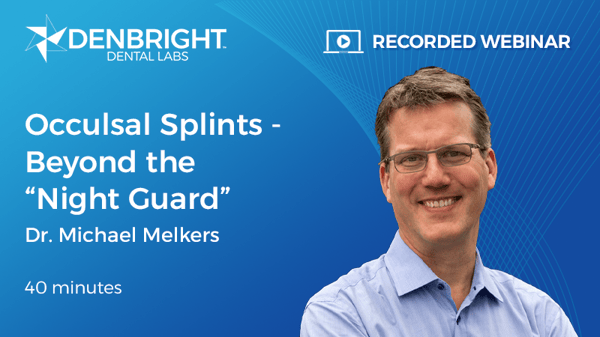
In the webinar “Occlusal Splints: Beyond the Night Guard,” internationally respected educator Dr. Michael Melkers breaks open a new way of thinking about splints—, not just as bite guards, but as diagnostic, therapeutic, behavioral, and esthetic tools. This in-depth discussion covers real-world strategies for integrating splints into daily practice, improving patient understanding, and delivering better clinical outcomes.
The Misunderstood Splint: More Than a Billable Code
According to Dr. Melkers, too many clinicians view splints as a single-use product, simply a “thing” to be billed. But when reconceptualized as a multi-functional clinical tool, occlusal splints become:
- A diagnostic indicator
- A pain relief and inflammation management tool
- A behavioral motivator
- An occlusal preparation device
- A temporization strategy
“Splints are not something we do to patients. They’re something we do with patients.”
— Dr. Michael Melkers
Diagnostic Power: Using Splints to Clarify Complexity
One of the most powerful messages from the webinar is the role splints play in clarifying diagnostic uncertainty.
When patients present with generalized wear, pain, or muscle issues but lack a clear etiology, a splint can deprogram the muscles and reduce inflammation, allowing the underlying issue to surface.
“Occlusion is not the enemy, and it's not the cause of every problem. Splints let us clear the fog and see what we’re really dealing with.”
— Dr. Melkers
Pain Relief + Behavioral Insight = Case Acceptance
Melkers emphasizes that splints are behavioral influencers. When patients wear them, they experience relief. That “aha!” moment can move patients toward larger treatment acceptance.
This includes:
- TMD patients who feel muscle relief
- Bruxers who begin to understand the source of their wear
- Patients with morning headaches who link them to nighttime parafunction
Key point: If your splint helps the patient feel better, they’re more likely to accept future treatment, whether it’s restorative, esthetic, or ortho.
The Esthetic Bridge: Transitioning from Splint to Smile
Splints also serve a powerful role in esthetic diagnostics and visualization.
Melkers shows how a splint can be used to:
- Test changes in vertical dimension
- Evaluate speech and phonetics
- Prepare patients for restorative esthetics
Instead of jumping straight to permanent restorations, clinicians can use a splint to “preview the future.” Patients can try on a trial smile, provide feedback, and build trust before committing to treatment.
“Patients can live with the change before they pay for the change.”
— Dr. Melkers
Functional Guidance: From Wear to Workflow
Splints aren’t just passive appliances. They guide the function and identify issues.
Melkers introduces a system of “Red Flags” that clinicians should watch for when adjusting or following up on splints:
- Fracture lines or delamination – stress indicator
- Canine wear – parafunctional habits
- Posterior engagement – muscle-driven movement
- Tension marks – clenching patterns
When these signs are present, the splint becomes a map of the patient's behavior, a visual cue for the clinician to adjust treatment plans.
Analog or Digital: The Delivery Doesn’t Matter, The Intent Does
Melkers doesn’t fixate on digital vs. analog splint fabrication. Instead, he emphasizes the appliance's intent.
Whether fabricated by hand, milled, or printed, the power lies in how the splint is used, explained, and integrated into the patient journey.
Digital technology certainly enhances consistency and turnaround time, but the splint must still be:
- Functionally guided
- Patient-tailored
- Communication-ready
The Power of Language: Explaining Splints Without Confusion
One of the biggest takeaways is how to talk to patients about splints without scaring or overwhelming them.
Avoid terms like:
- “Occlusal guard” – sounds scary or medical
- “Night guard” – oversimplifies its use
- “Bite splint” – may confuse patients
Instead, Melkers recommends descriptive explanations tied to their needs:
“This is a custom-fit mouthpiece that helps reduce your jaw muscle tension while you sleep. It also protects your teeth from grinding and helps us better understand how your bite works, so we can make smart choices if future treatment is needed.”
Chairside Wisdom: Tips for Daily Practice
- Splints first, diagnoses second.
Use splints to deprogram the system before committing to a diagnosis. - Don’t chase symptoms too early.
Let the splint stabilize before evaluating long-term treatment options. - Involve the patient in the journey.
Use splints to “try out” treatment changes, mainly vertical and functional shifts. - Watch for feedback clues.
The way a patient wears, or avoids, wearing their splint provides real behavioral data. - Document the story.
Each time a splint is adjusted or commented on by the patient, record it. This builds the record for future work.
When Splints Fail: The Clinical Reflection Opportunity
Melkers also warns that splints that aren’t used or don’t deliver results are learning opportunities.
Instead of seeing a “failed” splint as a problem, clinicians should ask:
- Was the diagnosis wrong?
- Did we explain it well enough?
- Was the splint designed for the patient’s actual behavior?
He emphasizes designing with intention, adjusting with empathy, and learning with humility.
The Takeaway: Elevate Your Splint Strategy
Occlusal splints have long been considered a “night guard” solution for bruxism. But as Dr. Michael Melkers makes clear, they can be:
- A pre-treatment trial for larger restorations
- A functional appliance to reduce symptoms
- A patient motivator to elevate case acceptance
- A recording device to observe behavior
- A communication tool to build trust
Whether you work in a solo practice, group practice, or DSO, embracing this broader view of occlusal splints can lead to more accurate diagnoses, smoother workflows, and better patient outcomes.
“When a patient feels better wearing their splint, they understand their own symptoms in a new way. That’s when they become motivated to fix the bigger problem.”
— Dr. Michael Melkers
Explore More from Denbright Education
Interested in learning more about digital workflows, restorative esthetics, and advanced case planning?
Join our upcoming live and on-demand webinars >>