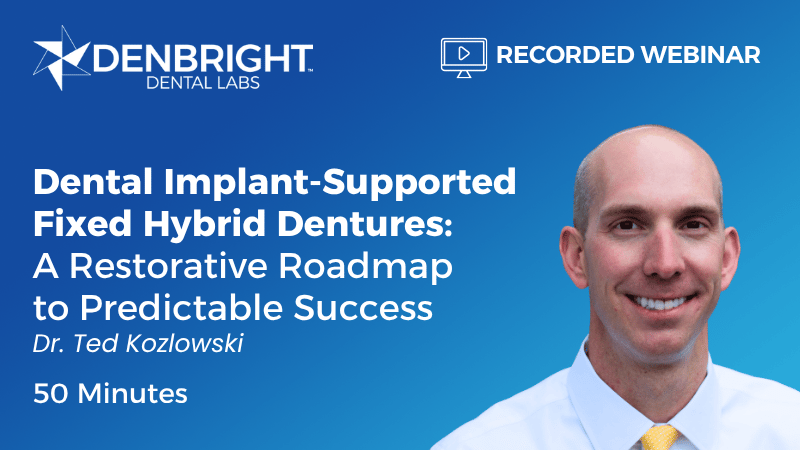
A Roadmap to Predictable Success
How restorative planning, digital records, and laboratory collaboration can improve full-arch treatment workflows
Based on a clinical webinar presented by Ted Kozlowski, DDS
Implant-supported fixed hybrid dentures offer patients with failing or missing dentition an opportunity to regain function, aesthetics, and confidence. However, these cases require restorative dentists to plan carefully, coordinate with the surgical team, and rely on a reliable laboratory workflow.
In a Denbright educational webinar, general dentist Dr. Ted Kozlowski shared the clinical protocol he has developed through years of restoring full-arch implant cases. Working with Friendship Dental Lab, part of the Denbright laboratory family, he has transitioned from lengthy chairside conversions to a digital workflow incorporating:
- restorative planning,
- photogrammetry, and
- laboratory-fabricated PMMA healing hybrids
His experience provides a practical roadmap for dentists seeking to improve the predictability and efficiency of implant-supported fixed hybrid treatment.
Establish the Restorative and Surgical Workflow Before Presenting Treatment
Successful full-arch treatment begins with collaboration among the restorative dentist, surgeon or periodontist, and dental laboratory. Before presenting implant-supported fixed treatment to patients, Dr. Kozlowski recommends meeting with the surgical provider to establish the treatment sequence, responsibilities, and financial arrangements. Both providers should understand which services they will perform, who will supply implant components, and how they will handle laboratory expenses.
This preparation also simplifies patient consultations. When patients ask how much treatment will cost or how long it will take, the restorative dentist can explain the anticipated process and the fees associated with each provider.
Equally important, the surgical plan should support the intended restoration. Rather than determining implant positions independently of the restorative design, Dr. Kozlowski works with his surgical team and laboratory to establish the desired tooth positions and functional requirements first.
Evaluate Patient Expectations and Treatment Readiness
Patients seeking fixed full-arch treatment arrive with different experiences and expectations. Some have failing dentition from extensive caries or periodontal disease but remain accustomed to chewing with natural teeth. Others have worn removable dentures for decades and have already adapted their diets and chewing habits. Younger patients may need their restorations to function for many years and should understand the possibility of future prosthetic maintenance or replacement.
Dr. Kozlowski stresses that these differences should guide the initial consultation. Patients accustomed to natural teeth need to understand the limitations of the healing period, including dietary restrictions. Long-term denture wearers may need help understanding how fixed implant-supported treatment differs from their current prosthesis.
He also recommends discussing maintenance, home care, future expenses, and potential speech changes before treatment begins. Establishing realistic expectations early reduces the need to explain unexpected limitations or additional appointments later.
Collect the Records Needed for Accurate Digital Planning
Dr. Kozlowski identifies incomplete initial records as a common source of problems during case design and fabrication. His protocol begins with a consistent series of patient photographs, including frontal views at rest and smiling, a broad smile showing maximum lip mobility, and profile views at rest and smiling.
These photographs help evaluate facial proportions, incisal display, upper lip support, and the prosthetic transition line. They also provide valuable references for communication with the patient, surgeon, and laboratory.
The photography process does not need to be complicated. Dr. Kozlowski recommends starting with a dedicated office smartphone, a consistent background, appropriate lighting, and a simple photography checklist. Every trained team member should be able to capture the required images.
Digital intraoral records should include both arches, bilateral bite registrations, and sufficient soft tissue anatomy for laboratory planning. He recommends extending the digital models into the vestibule and capturing the palate to provide additional landmarks.
The restorative dentist should also evaluate the patient's existing occlusion. Missing posterior teeth, a collapsed vertical dimension, or a discrepancy between maximum intercuspation and centric relation may require additional records before designing the case. When necessary, a new centric relation record or an appliance to establish a reproducible vertical dimension can help guide the restorative setup.
Design for Aesthetics, Function, and Phonetics
Full-arch restorative planning requires more than selecting tooth shape and shade. Dr. Kozlowski evaluates each case in three categories: aesthetics, function, and phonetics.
Aesthetic considerations include maxillary incisal display at rest, smile line, lip mobility, buccal corridors, occlusal plane, and upper lip support. The design must also account for whether the patient needs prosthetic gingiva and where the prosthesis-to-natural-tissue transition will appear.
Functional planning includes vertical dimension of occlusion, overjet, overbite, occlusal relationships, and potential lateral forces on the implants.
Phonetics also deserves attention. Changes in tooth position, incisal edge location, or vertical dimension can affect speech. Some adjustments can be addressed through prosthetic design, while others may require patient adaptation.
Dr. Kozlowski uses digital smile design to communicate the anticipated result before the patient accepts treatment. Friendship Dental Lab can also develop the smile design from submitted patient photographs, allowing dentists to incorporate this step without designing it themselves.
When a patient already wears a denture, the existing prosthesis can provide useful information. A denture that fits and functions well may be duplicated for planning. If the existing denture is unsatisfactory, the laboratory can fabricate a printed try-in based on digital records and the proposed new design.
Use Restoratively Driven Implant Planning
Once the proposed tooth positions and occlusion have been established, the restorative dentist, surgical team, and laboratory can coordinate implant placement. Dr. Kozlowski emphasizes maximizing the anterior-posterior spread of implants while considering available bone, implant dimensions, and the amount of posterior support needed. These factors influence the allowable cantilever length and the final restorative design. Narrow posterior ridges or smaller-diameter implants may limit how far posterior teeth can extend beyond the implants.
The healing hybrid also requires special consideration. In his protocol, Dr. Kozlowski generally avoids placing teeth distal to the most posterior implant in the polymethyl methacrylate (PMMA) healing hybrid. This limits cantilever loading during healing, when patients may gradually become less cautious about dietary restrictions. He explains this distinction during the preoperative consultation, so patients understand why the healing restoration may have fewer posterior teeth than the definitive prosthesis.
Use Photogrammetry and a Laboratory-Fabricated Healing Hybrid
One of the most significant changes in Dr. Kozlowski's workflow has been moving away from extensive chairside fabrication of the provisional restoration. Following implant placement, the surgical team seats the multi-unit abutments. Photogrammetry captures their positions, allowing the laboratory to relate the implant locations to the previously developed digital restorative design.
Friendship Dental Lab uses these records to fabricate a PMMA healing hybrid for delivery at the restorative appointment the following day. This approach reduces the need for chairside pickup, reshaping, and polishing that characterized Dr. Kozlowski's earlier cases. It also provides a provisional restoration designed around the patient's planned tooth positions and aesthetics.
At delivery, he follows a consistent sequence: placing prosthetic screws, verifying seating, checking occlusion, and obtaining radiographs to confirm the restoration is fully seated on the multi-unit abutments. He also checks that no screws remain lodged in the access channels before seating or reseating a prosthesis.
Establish a Follow-Up and Maintenance Schedule
Delivery of the healing hybrid is not the end of treatment planning. Dr. Kozlowski schedules follow-up appointments to evaluate occlusion, tissue healing, and the patient's ability to maintain the restoration. His sequence includes a one-week visit, a one-month evaluation, and a three-month hygiene and healing assessment.
At the one-week appointment, he reassesses occlusion and makes adjustments as needed. This is particularly relevant when treatment has changed the patient's vertical dimension and the muscles are adapting to a new functional position. He also reinforces home care instructions, including cleaning beneath the prosthesis as the tissues heal and the space beneath the restoration changes.
At one month, he checks occlusion, home care, and the condition and use of any prescribed occlusal guard.
At approximately three months, he evaluates the soft tissues for inflammation, calculus, or exudate before obtaining definitive restorative records. If tissue health is inadequate, additional care may be needed before proceeding. This appointment also provides an opportunity to evaluate whether the intaglio surface of the final restoration should be modified to improve the patient's access for cleaning.
Transfer the Verified Healing Design to the Final Restoration
A major advantage of the digital workflow is using the healing hybrid as a reference for the definitive prosthesis.
Once the patient has adapted to the healing restoration and the dentist has verified aesthetics, occlusion, function, and tissue health, the laboratory can use updated digital records to reproduce the successful design.
Dr. Kozlowski describes this as a significant benefit of digital dentistry. Instead of starting the definitive restoration from the beginning, the team can build on the adjustments and clinical information collected during healing.
He commonly selects zirconia for definitive full-arch restorations, while recognizing that material selection and prosthetic design depend on the individual case.
Laboratory Collaboration Supports a More Predictable Workflow
Dr. Kozlowski's experience demonstrates how a structured restorative protocol can improve the management of complex full-arch cases.
The essential steps begin well before implant placement: selecting appropriate patients, communicating realistic expectations, capturing complete records, establishing the intended restorative design, and coordinating that design with the surgical team.
Digital planning, photogrammetry, and laboratory-fabricated healing hybrids can reduce chairside fabrication demands and make the transition from provisional to definitive treatment more efficient.
Through Friendship Dental Lab and the broader Denbright laboratory family, dentists can access digital design and restorative support appropriate to their existing workflows. Whether a practice is beginning to incorporate digital technology or already uses intraoral scanning and advanced restorative planning, laboratory collaboration can help make full-arch treatment more systematic.
Watch the Webinar for the Complete Clinical Protocol
In the full webinar, Dr. Kozlowski discusses his clinical cases and provides additional guidance on patient selection, digital records, vertical dimension and occlusal planning, photogrammetry, healing hybrid delivery, and follow-up care. He also shares practical techniques developed through his collaboration with Friendship Dental Lab, part of the Denbright laboratory family.
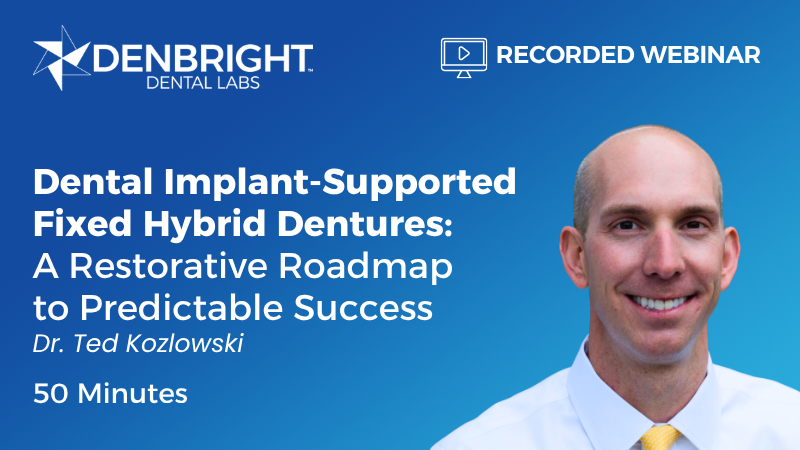
Watch the Full Webinar, Dental Implant Supported Fixed Hybrid Dentures: A Roadmap to Predictable Success, to see the case examples and hear Dr. Kozlowski's expanded clinical discussion.