Loss of bone and soft tissue presents challenges to optimal dental implant treatment. When faced with these challenges, enlisting an interdisciplinary approach involving orthodontics, along with the use of a cantilever, can provide solutions to complex cases.
In this case, the patient presented with significant osseous loss in the maxillary anterior region, creating a risk for compromised esthetics, poor tissue support, and an unpredictable restorative outcome.

The initial presentation showed recession, discoloration, and an inadequate peri-coronal architecture.
To avoid aggressive grafting procedures, the team planned orthodontic extrusion to bring the surrounding bone and soft tissue coronally. A cantilevered pontic was then used to support the peri-coronal tissues during the transition phase,
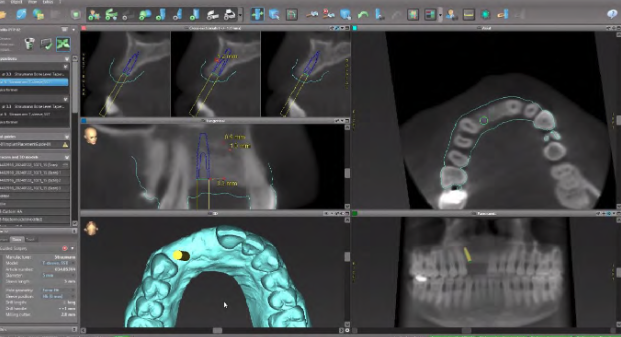
Implant planning software guided the ideal positioning of the implant at the lateral incisor site.

Digital planning overlay demonstrating prosthetically driven implant positioning.
A guided approach was used during implant placement to ensure accuracy. 
After implant placement, soft-tissue contours were secured and allowed to mature.
After osseointegration, an anatomic screw-retained provisional restoration was placed to sculpt the soft tissue. Over time, tissue maturation produced a natural 360-degree sulcus without residual ridge-lap areas.
A final digital scan captured the mature tissue form, allowing the definitive restoration to replicate the emergence profile created by the provisional seamlessly. 
The case was completed with a screw-retained two-unit fixed prosthesis supported by a custom abutment. Monolithic ceramic material ensured strength, longevity, and shade consistency in this demanding esthetic region.
Through coordinated orthodontic, surgical, digital, and restorative workflows, the team achieved a stable, functional, and esthetic outcome without resorting to extensive grafting. This case demonstrates how an interdisciplinary foundation can overcome challenging anterior conditions while delivering a highly natural result.